When food heals
On Japanese films centred around food

You know this feeling when, after a busy and stressful day, your loved one puts a bowl of nutritious soup in front of you with a smile and it feels like a warm hug. Or you feel your mum’s love when you unwrap sandwiches she packed for you for a school trip. You sense that it’s easier to share your troubles and worries with a friend over delicious cake and a pot of good tea.
Even though it may sound trite, I’ll say it: food has magic properties, and in cinema no one understands it better than the Japanese. I recently designed a filmotherapy course for myself. In an effort to foster emotional healing after having been afflicted with severe trauma, I watched various Japanese films centred around food. Despite having started my project with an open mind, I still ended up surprised at how positive the results are, and therefore I would like to share the films with you. You may watch them all or enjoy one or two that particularly appeal to you and suit your needs.
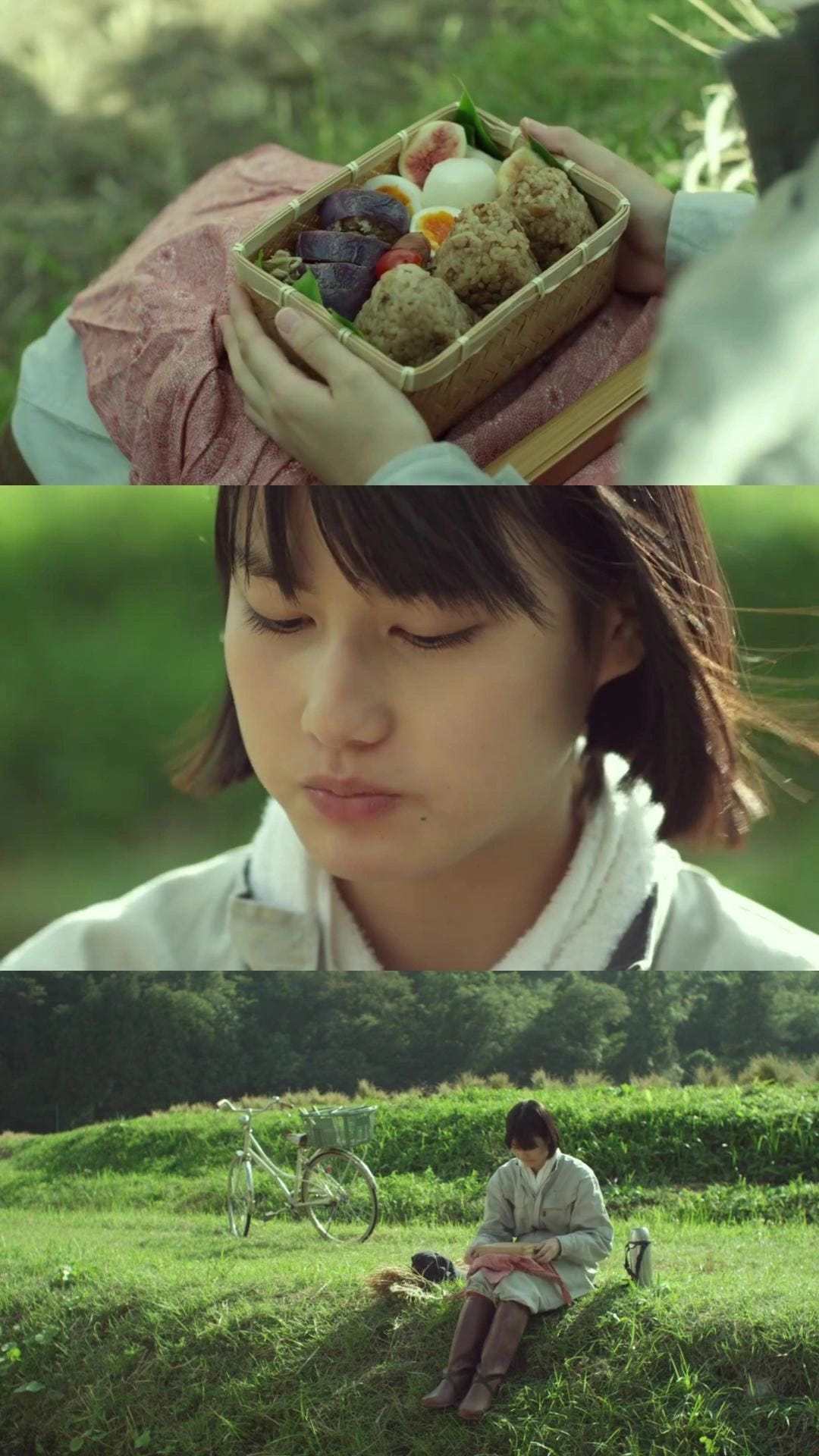
“Little Forest”
Many of the characters start cooking and take it seriously as serdendipity enters their lives. Ichiko from “Little Forest” (by Junichi Mori, 2014-2015) grows tired of living in a big city, so upon returning to her family house (empty after being abandoned by the girl’s mum) she finds solace in farming, cooking simple dishes from local, seasonal ingredients, and slowly becoming engaged in life of the local community. Food becomes the centre of her life, her raison d'être, and observing the practice of eating plants at their peak of freshness and flavour is truly humbling, raising many questions as to our relationship with food. Tokue, a lady in her seventies, from “Sweet Bean” (by Naomi Kawase, 2015) starts working in a dorayaki shop as she had always dreamed of it and convinces the taciturn owner to hire her; her presence and warm attitude softens the hearts of people around. Natsume from “Patisserie Coin De Rue” (by Yoshihiro Fukagawa, 2011) begins her career in a patisserie as she encounters the place by chance, looking for her boyfriend who had moved to Tokyo and stopped writing. She develops passion for preparing sophisticated pastries and her stubbornness pays off.
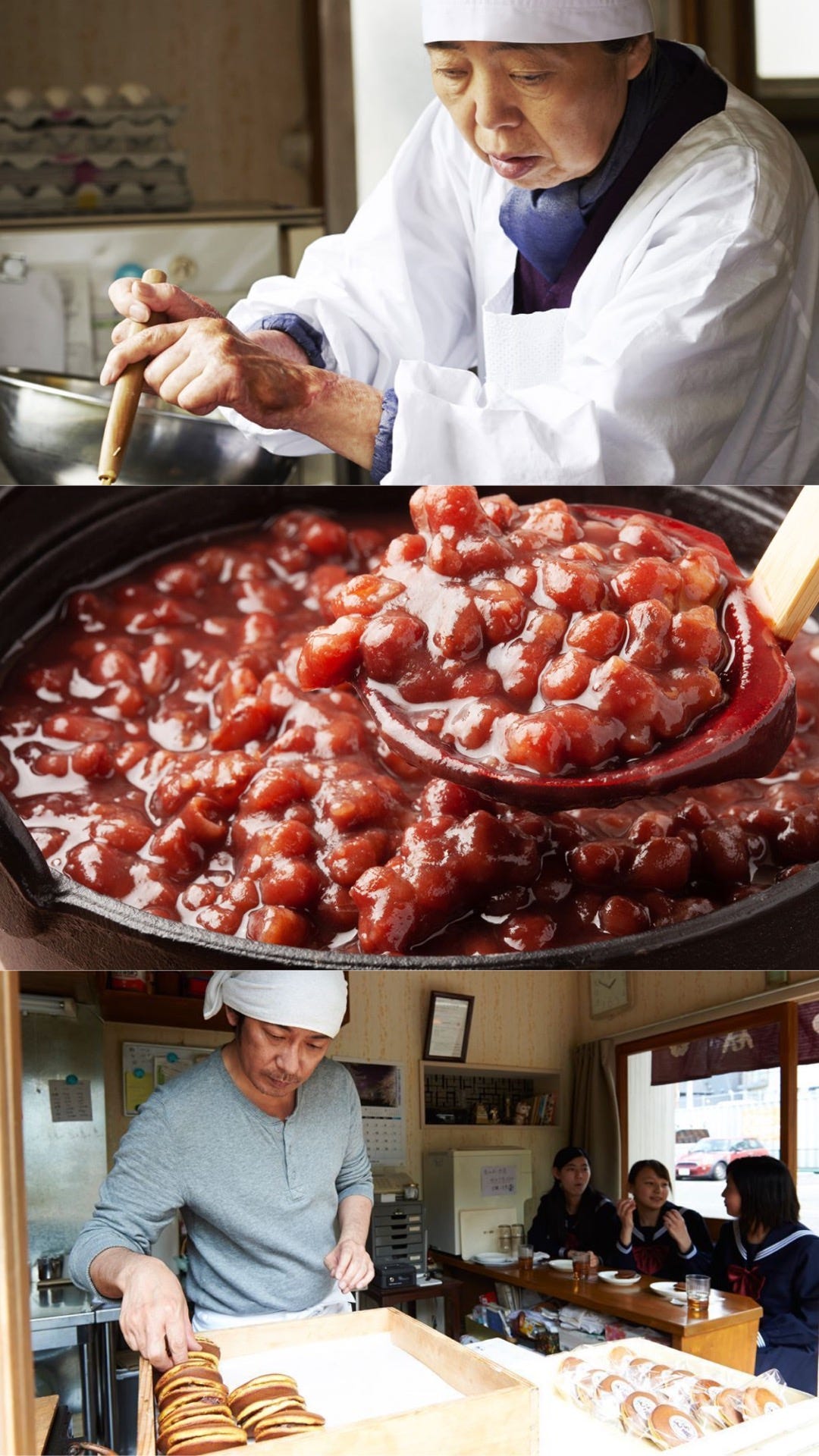
“Sweet Bean”
Here, we can also observe kaizen (改善), the process of continuous improvement thanks to many small steps towards a satisfying goal. Whether it is Natsume from the aforementioned “Patisserie…”, working hard to perfect her pastries and cakes, or the father and daughter making the perfect tofu from “Takano Tofu” (by Mitsuhiro Mihara, 2023), or Wataru, a local farmer from “Restaurant from the Sky” (by Yoshihiro Fukagawa, 2019) trying for a decade to make cheese he would be truly proud of, we see determined protagonists not cutting corners but constantly improving to make a one-of-a-kind final product. The most iconic film on kaizen and food, though, is surely “Tampopo” (by Jūzō Itami, 1985). With a lot of sense of humour, many phenomenally erotic vignettes with food in the centre, the main story revolves around the eponymous ramen restaurant owner, who asks two visitors to teach her how to cook the perfect bowl of ramen. One doesn’t look at this humble noodle soup in the same way after watching this film.
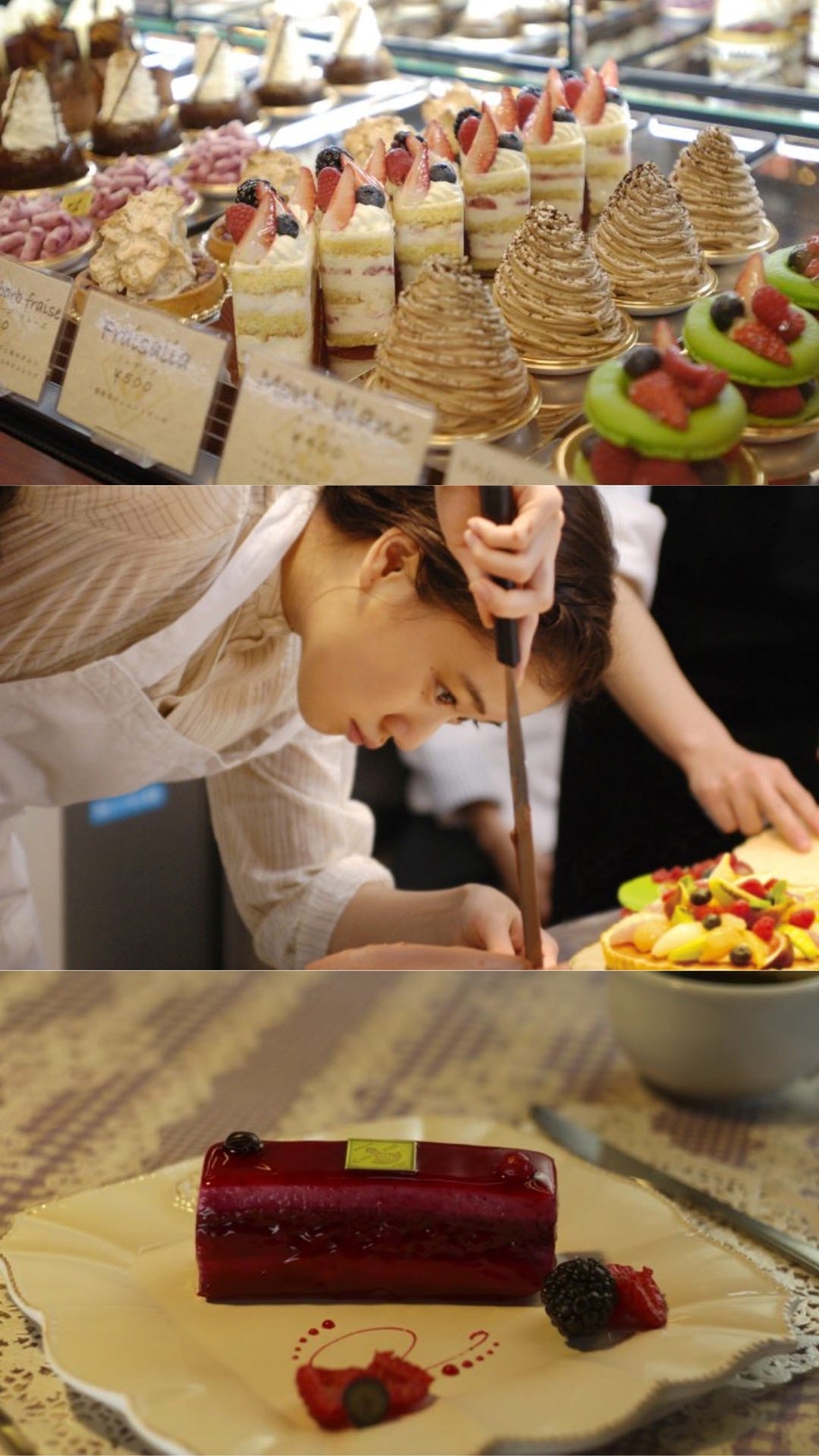
“Patisserie Coin De Rue”
In recent years the Japanese concept of ikigai (生き甲斐), translated as “a reason for being” or “a sense of purpose”, became popular outside of Japan. Motivational books, often written by non-Japanese authors, discussing this existential idea and guiding readers how to find the purpose of their own lives, can be found in every bookshop. In Japan ikigai is often shown rather than talked about and overanalysed. In films about food we see people who find a sense of purpose in cooking and making others happy with their creations. Mr. Nishimura from “The Chef of South Polar” (by Shuichi Okita, 2009), the chef cooking for two years for a group of eight men working at an Antarctic research station, finds it his mission to brings smiles to his colleagues, who far away from home, missing their families, in freezing temperatures, struggle with homesickness, mental health issues and lack of entertainment. The smile with which he watches these men gather at a table and eat tempura, steak or ramen, is for me the highlight of the film. Three quirky ladies from “Kamome Diner” (by Naoko Ogigami, 2006), working in a Japanese restaurant opened by one of them in Reykjavik, Finland, find purpose in connecting with people through Japanese cuisine they introduce their Finnish customers to. Teenage Kiyo from “The Makanai; Cooking for the Maiko House” (by Hirokazu Koreeda, 2023), who together with her friend Sumire goes to Kyoto to learn how to become a maiko (an apprentice geisha), is quickly deemed unfit to realise that dream. She notices, though, that the dishes she cooks warm hearts of other girls and bring comfort, so she finds her true calling in cooking for everyone in the house, which gives her much more joy anyway.
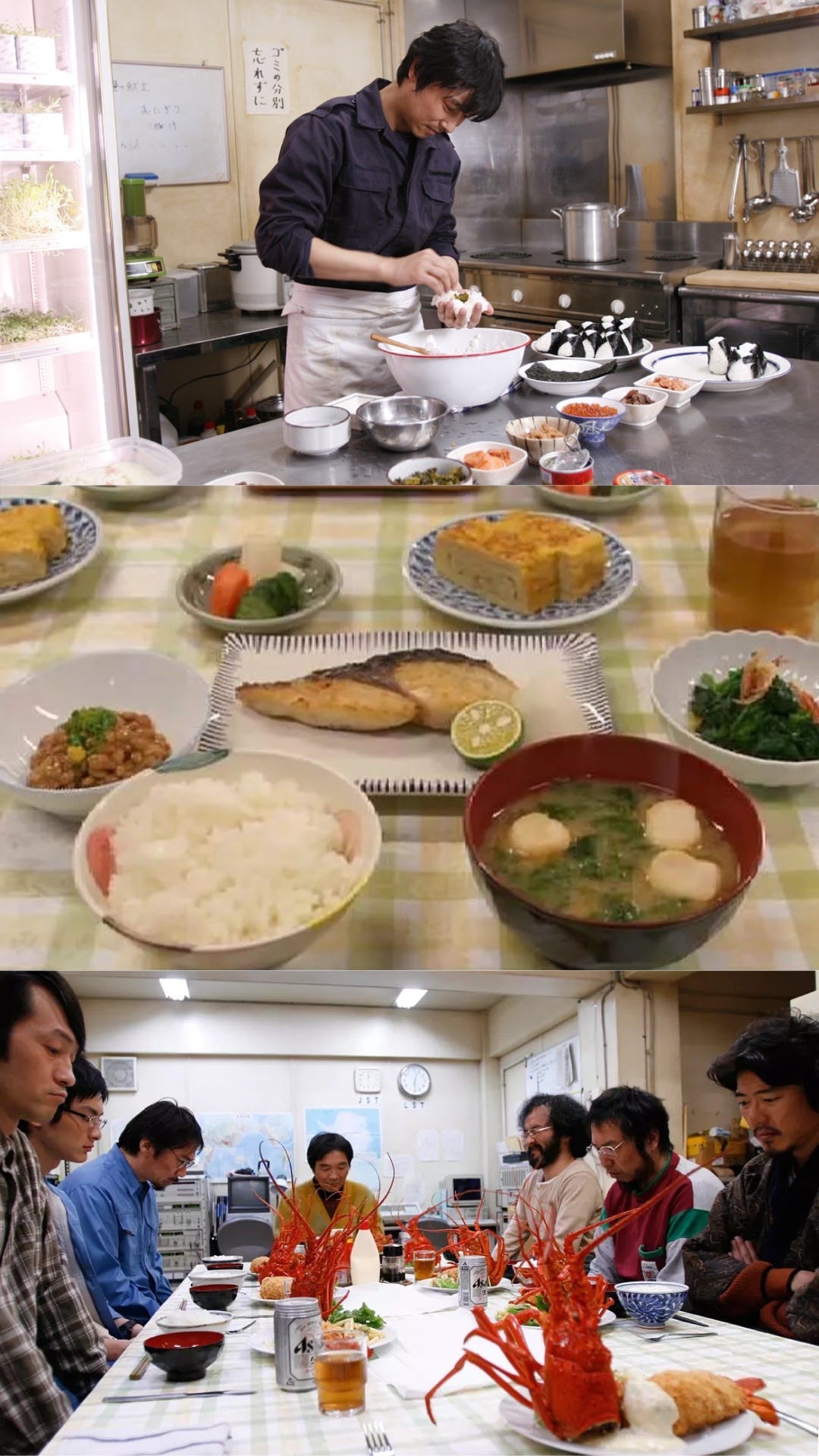
“The Chef of South Polar”
How easily we observe that cooking for others and bonding with others over food is what gives genuine pleasure and a sense of accomplishment to many protagonists. Food connects strangers and family members, it has the power to heal all pain (albeit sometimes temporarily), and make it easier to endure hardship and combat challenges that life throws at us. The chef of wonderful series “Midnight Diner” (by Jōji Matsuoka, 2014) knows it best. With the dishes he cooks for his late-night customers he learns their stories and gets the key to their hearts. Food becomes a bridge connecting cultures and identities for women in “What’s for Dinner, Mom?” (by Mitsuhito Shiraha, 2016), in which two adult daughters find a notebook with Taiwanese recipes after their mother’s death and reminisce about their mother’s struggle to raise them singlehandedly in Japan, while missing Taiwan where she had lived as a young woman and where she met the daughters’ Taiwanese father. Taiwanese dishes she cooked in Japan were an expression of her nostalgia for the happier times. In “Bread of Happiness” (by Yukiko Mishima, 2012) delicious simple dishes, centres around good bread and coffee, transform customers who enter the gorgeously located bakery with heavy hearts but leave feeling lighter, more cheerful, more optimistic thanks to great food and care and attention they experience from the owners. Seasonality of shared food is shown beautifully in “Little Forest” but also in “The Zen Diary” (by Yūji Nakae, 2022), in which elderly Tsutomu, living alone in the mountains of Nagano, cooks delicious meals made from local ingredients and shares them with his editor-friend when she visits. Serenity and peace coming from living off the land, at the pace dictated by nature - simply watching it brings solace to a tired heart. “Doesn’t food taste the best when you share it?” is a common refrain, expressed by Kiyo from “Makanai…” but shared by characters of so many of these films, as a rendition of the Japanese proverb “Even sea bream is not delicious when eaten in loneliness” (鯛も一人はうまからず) , which highlights that company and atmosphere are essential to our enjoyment of food and life.
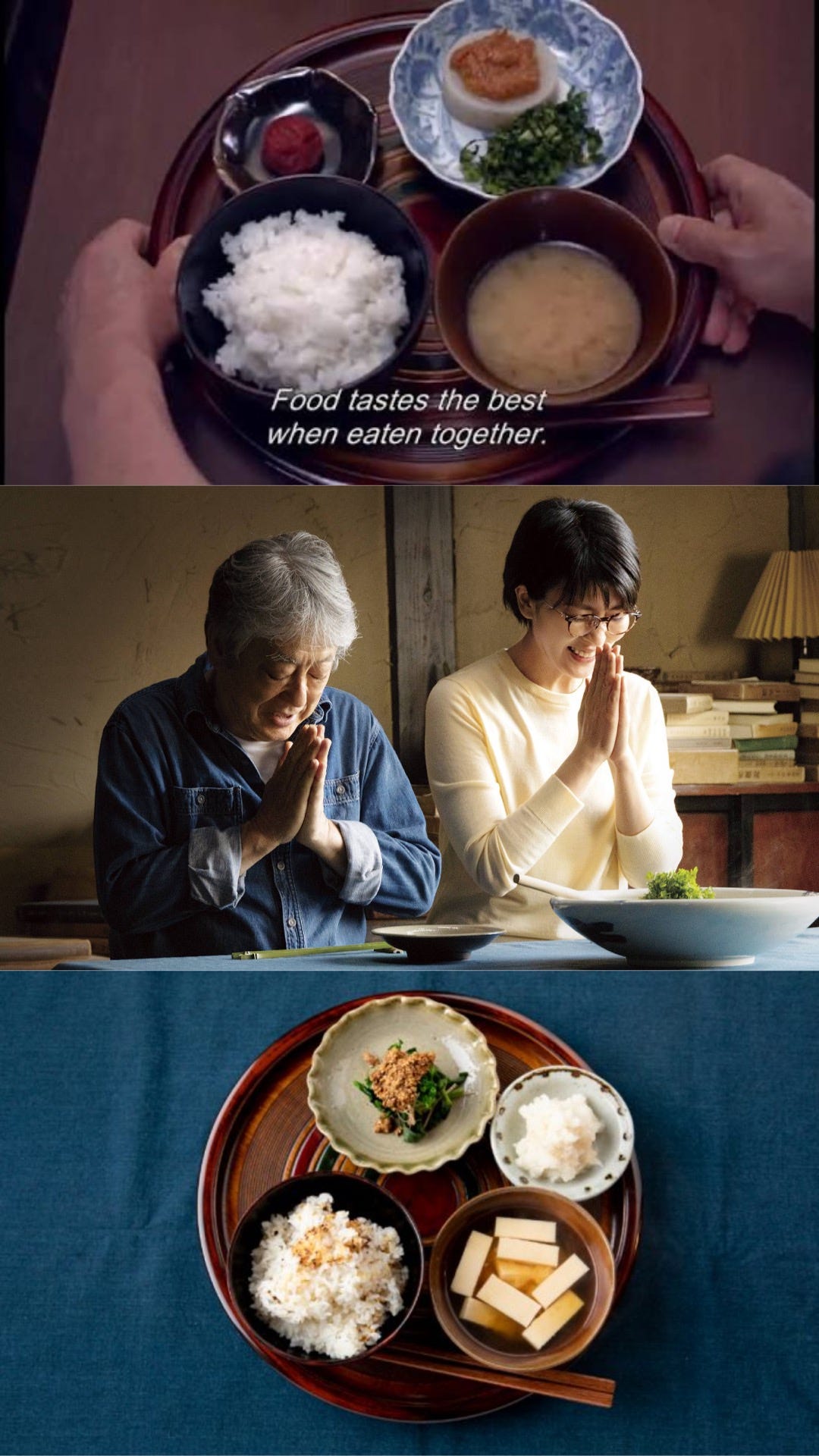
“The Zen Diary”
Many Japanese people would say that they have difficulty communicating with others in words, also when it comes to communicating love, affection and care (or maybe especially these). While this may be true for a lot of people, a special case, worldwide, is communication between parents and their teenage children. Action speaks louder than words, and here again food succors. “Dad’s Lunch Box” (by Masakazu Fukatsu, 2017), in which a divorced father commits himself to making his teenage daughter a bento lunch box throughout all her years of high school is a moving example of how continuous effort and commitment nurture and deepen their relationship. On the other hand, “Bento Harassment” (by Renpei Tsukamoto, 2019), with a mother preparing a bento box for her teenage daughter she raises on her own, has a more playful tone as the mother sends embarrassing messages in her creative lunch designs (hence ‘harassment’ in the title). It does bring them closer, though. Even seemingly cold and easily ashamed teenage girls are grateful for the love and attention they receive from their parents.
I found the Japanese concept of ba no kuuki wo yomu (場の空気を読む), which can be translated to ‘reading the air’ - the vital skill of sensing the atmosphere and emotions - also expressed in certain films where food is the centre, the glue connecting people. In “Makanai…” Kiyo is so loved among other maiko because she always prepares what she feels they need to eat to release stress and to cheer up. This level of thoughtfulness can also be observed in slightly wacky “Rinco’s Restaurant” (by Mai Tominaga, 2010), in which young woman Rinco returns to her hometown after a difficult breakup and opens a restaurant behind her mother’s house. She serves only one customer (or a group) a day and doesn’t provide a menu. She cooks what her intuition tells her they need to eat to feel better, more alive, more attuned to their emotions. ‘Reading the air’ applies also to eight women who support themselves and each other by cooking and eating delicious meals - or having them cooked for them - in “Eating Women” (by Jirō Shōno, 2018). They meet, discuss their loneliness, love and sexual relationships, help each other thrive and remain friends for good and bad times. It’s healing cinema at its core.
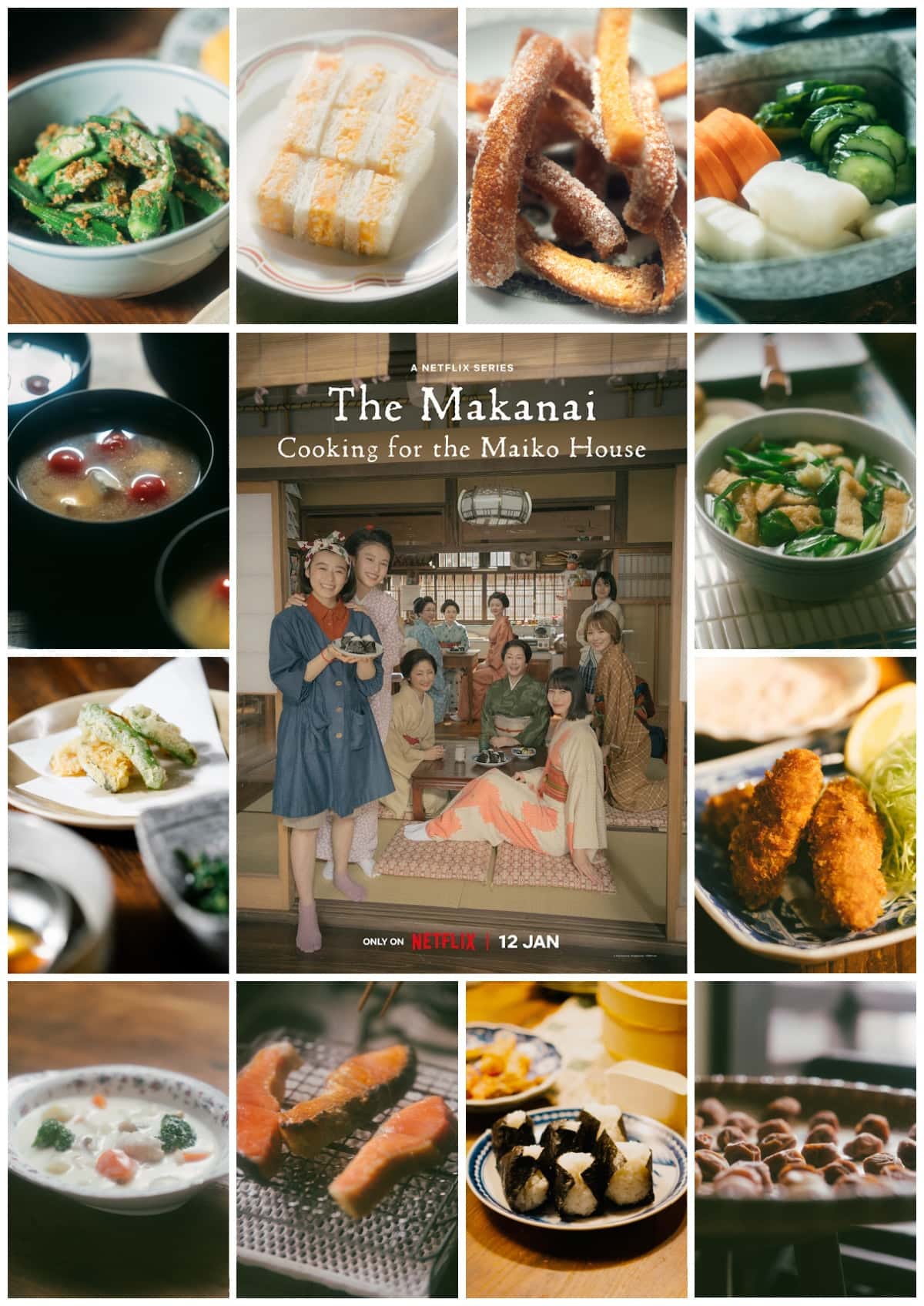
“The Makanai; Cooking for the Maiko House”
I left two documentaries for the end of this text. Both “Come Back Anytime” (by John Daschbach, 2011) and more famous “Jiro Dreams of Sushi” (by David Gelb, 2011) were made by non-Japanese directors and in the same year. Both talk about dedication and passion for cooking of two male Japanese chefs from Tokyo. One cooks ramen, another one prepares sushi. Both are renowned and beloved chefs, with extraordinary reputation. The films show how much making food and making people happy became ikigai of both men (and Jiro’s son who works with his father) but it also emphasises the role of food in this delicate work of caring for customers’ wellbeing.
Watching these films, hearing countless itadakimasu and oishii, I felt my soul stretching, my heart opening to receiving and feeling gratitude, not only for the food I prepare myself or let others prepare for me, but also for everything else in life. I take the holistic approach, appreciating patience - needed for plants to grow but also for pain to heal, mindfulness - being aware and appreciative of now and here, and moderation - not being motivated by greed but by current needs. Moreover, I started cooking healthier meals and devoting more time to the process of preparation and the way of serving the dishes. This filmotherapy proved to be very beneficial for the body, mind and heart.
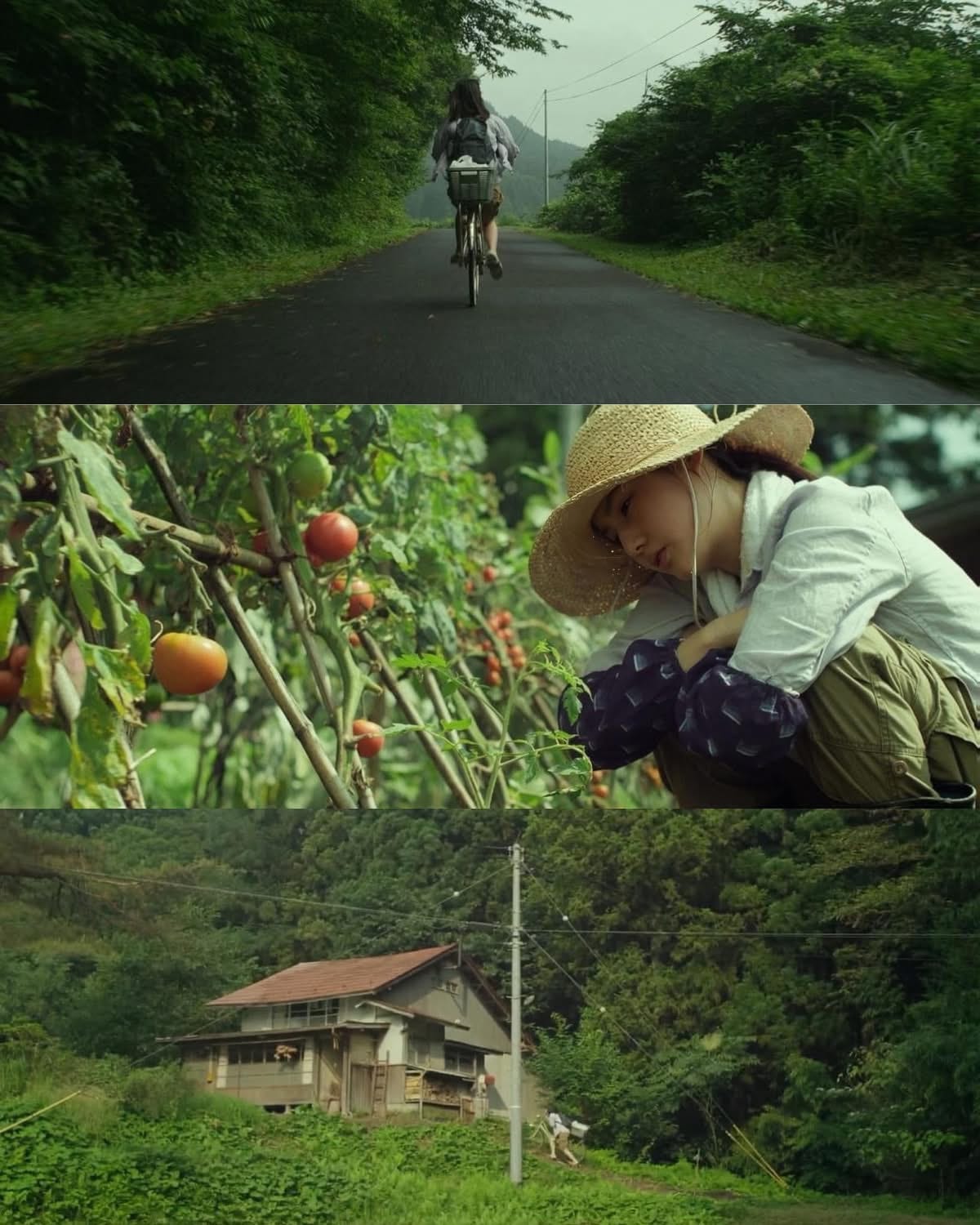
“Little Forest”